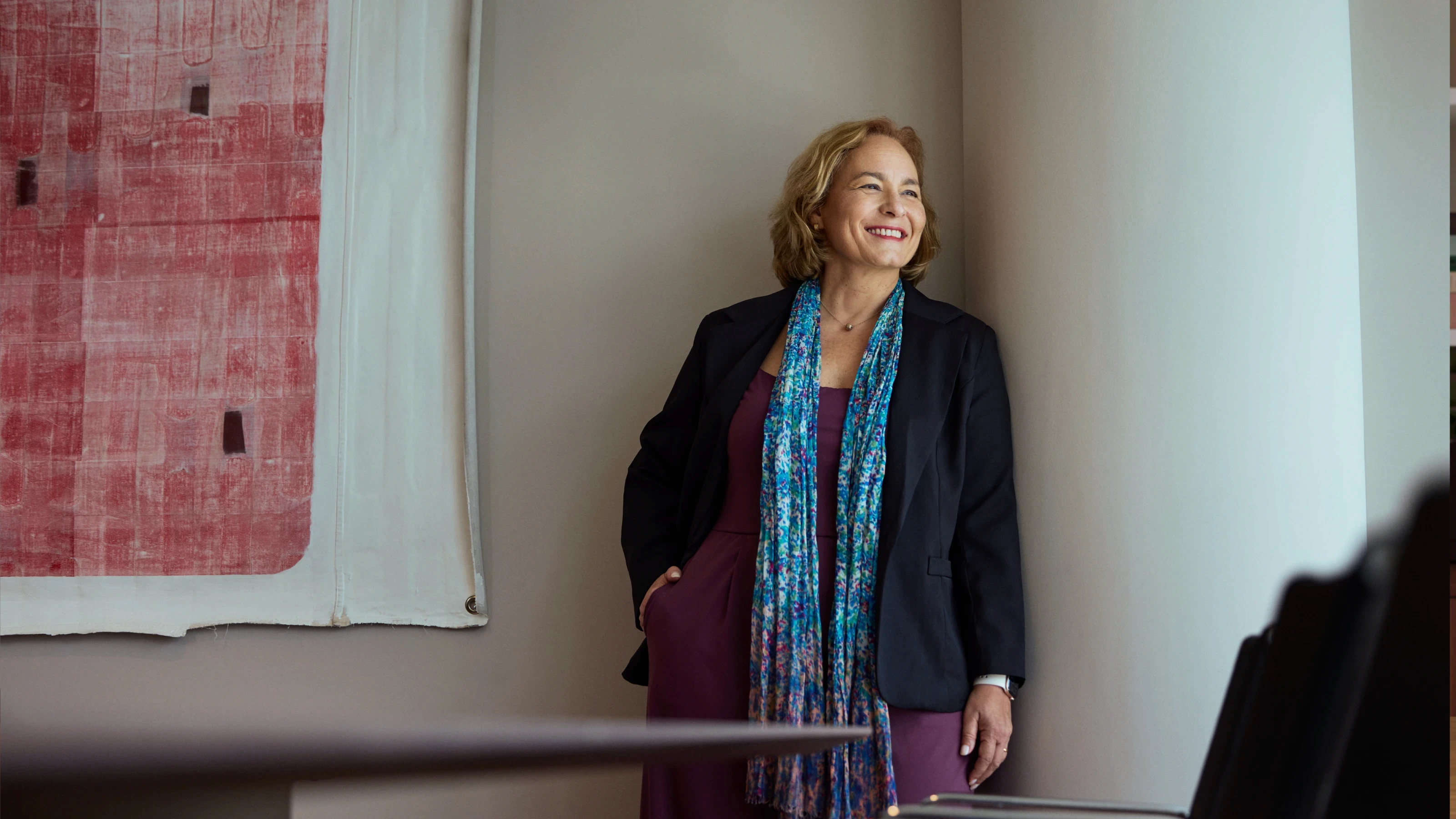
Sofia Martins is a partner at Miranda & Associados in Lisbon, co-head of its disputes practice, and one of ten arbitrators worldwide appointed to the ICSID Panel by the president of the World Bank.
She’s ranked by Chambers & Partners and Who's Who Legal Arbitration, and has lectured in arbitration at multiple Lisbon law schools for well over a decade. She built her career in Portugal, without an LLM from a foreign institution, or an internship at a Magic Circle firm, or indeed any of the markers that are widely assumed to be prerequisites for international standing.
In the conversation that follows, Sofia reflects on nearly three decades of practice, the decisions that defined her, and the conviction that drove each one.

The pull of justice and the appeal of arbitration
Sofia became interested in law at eight years old, watching Perry Mason reruns with her mother.
What appealed to her in those courtroom dramas was “a sense of justice; the truth coming out, the good guys winning in the end,” she says. “The theatrics and the cross-examining was probably the most fascinating part. It still is.” Her mind was made up by age ten, despite there being no lawyers in the family, no inherited network, and no obvious pathway into the profession.
When Sofia entered the profession in the mid-1990s, Portuguese law firms were still largely undivided by practice area. Everyone was, in her words, “a bit of a general practitioner.” She moved across litigation, corporate law, and real estate in those early years, developing a grasp of how different areas of the law connect and inform one another.
Her move into arbitration came later, when a client arrived wanting to contest an award in a case. The research required was enough to draw Sofia in completely.
“What became seductive about arbitration was the possibility of intervening in international disputes without involving the state courts of either country,” she explains. “Being able to resolve disputes in a shorter timeframe, with more flexible approaches, and with a procedure that's tailored to your case.”
Technical mastery coupled with diplomacy
The breadth of her early training is something she returns to frequently when asked what distinguishes great practitioners from good ones. “You’ll never be a great lawyer if you don't sift through thousands of pages and read each little line,” she says. “What you really need to do is put your hands in the dirt. You have to know the documents by number, name, and date.”
“What I see with younger generations is that they grow up so hyper-specialized from the outset that they often fail to see the big picture,” she says. “You can’t be a great arbitration practitioner if you don’t have experience, and you don’t get experience by only working on huge cases from the outset and without knowing the real world. You need to have your boots on the ground.”
But craft, for Sofia, extends beyond technical mastery. “A truly exceptional arbitrator has to combine a very good knowledge of procedural and substantive law, but it also has to be someone who is very intuitive, who understands the fundamentals.”
“Diplomacy,” she says, is invaluable, as is “having the emotional intelligence to read the room. It helps a lot in understanding the dynamics, and ultimately in having more peaceful and effective hearings.”
She illustrates the point with a story from her training period. She was in her mid-twenties, attending a courthouse hearing for the administrative purpose of collecting a judge’s signature – one of 60 required observations she needed to complete. The public defender hadn’t shown up, and a policeman asked whether she would stand in.
“I've never done this before,” she told him. The alternative was a civil servant with no legal training. “I thought, well, at least I have a degree in law.” It was daunting, she says, but exactly the kind of moment that can’t be manufactured in a structured training environment.
“You have to be thrown into the deep end, to go it alone and fend for yourself,” she says. “If you've always got someone sitting next to you, it's just not the same thing.”
Three decisions that shaped her career
Sofia’s career has been shaped by three pivotal moments. The first unfolded in 2003, following the birth of her daughter. Portuguese law firms at the time had no formal maternity policies, and Sofia returned to full-time work quickly, but it wasn't enough. “I basically got sidestepped in a bunch of cases,” she explains, “and that ultimately led to me leaving the firm.”
The second came two years later when her new firm collapsed after a clash between its two founding partners. She was 33, had just had her son, and was invited to follow one of the founders and become his partner. Two years after that, the firm was acquired by Uría Menéndez, and Sofia faced a harder choice: the acquisition had been driven by interest in the firm's labor practice, but she was a corporate and disputes lawyer.
She agonized, but in the end applied a logic she has since made a professional philosophy: what's the worst that can happen? She agreed to the acquisition, and it proved to be the decision that opened the international arena to her for the first time.
The third came in 2014, when Miranda & Associados approached her specifically. It wasn’t her only offer. A friend put the choice plainly: one firm had spotted she was available, whilst Miranda had specifically decided it wanted her. She accepted a nominal step back in seniority in exchange for the room to grow that she'd been looking for, and built the practice she now co-heads at Miranda.
In each case Sofia asked herself the same question, applied the same logic, and arrived at the same conclusion: just go for it.

From Lisbon to the world
A year and a half ago, an email arrived. Sofia had been nominated for appointment to the ICSID Panel of Arbitrators, one of ten candidates put forward by the president of the World Bank.
“I find myself in a kind of awe sometimes,” she reflects. “I'm a Portuguese national. Portugal is a small country at the very tip of Europe. I didn't study abroad, I didn't work abroad. I did my whole career here – no LLM, no internship at a major international firm. For someone with my background, and even more so as a woman, having made it into the arbitration spotlight – that's something I'm still getting used to. It's a mixed feeling between really scared and really proud. I still question if I really deserve it.”
She still gets nervous before every hearing, and she considers this a good sign: “The day I cease to have butterflies in my stomach, that's when something's really wrong. That means I'm not into it anymore. Nerves come hand-in-hand with responsibility.”
That sense of responsibility has also shaped how she thinks about success. Where once it meant titles, income, and the outward markers of having ‘made it’, success now means something quieter: “Doing what I like, with people that I like, and being able to manage my professional life and my personal life together.”
The pride her children take in her work, she says, is inseparable from who she is as a mother. "They understand that I'm only as good a mother as I am because I'm really happy and fulfilled professionally."
A generational shift
When asked what holds women back from putting themselves forward, Sofia is characteristically direct: “Women tend to have too much humility. We suffer with that. And I've been there many times.”
“But there’s a whole new generation of fabulous women who are starting to take a very important part of the market,” she says, “and this makes me incredibly proud. It's a generational shift.”
The advice she gives is simple: before turning down an opportunity, ask yourself honestly what you're actually risking. “The worst thing that can happen if you go for it is that you stay exactly where you are. The best thing is that you move forward.”
In 1973, the year she was born, Portuguese women could not work or travel abroad without their husband's permission. The distance from that to where Sofia now stands is no small thing. “We've come a long way,” she says. “Things evolve, maybe sometimes not as fast as we would like. But we're on the right path.”