Teach the Agent how you work. Skills let legal teams encode their standards, processes and preferences inside the Legora aOS™.
Today we're launching Skills, available to all Legora customers.
Skills enable lawyers to encode their ways of working so the Agent knows how to execute work to their standards. Every legal team knows the law. What sets them apart is how they practice it: the positions they take, how they structure their advice, the tone they strike with the other side.

That way of working takes years to build, and it's what makes their work recognizably their own. Some of it sits in playbooks, or in precedents, or in the experienced heads of the lawyers who built them. Skills turns it into instructions the Agent can follow on every task.
"What I find valuable about Skills is that it gives us a consistent process while still being flexible. It adapts to the information provided, asks questions when it needs more context, and helps us get to the result we actually need."
– Kiren Bigwood, Senior Growth Manager, Hamilton Locke
What are Skills?
A Skill is a set of natural language instructions, saved as a Markdown file, that teaches the Agent how to approach a specific legal task. It captures three things: the standards your team holds its work to, the processes it follows, and the preferences that make the work recognizably yours.
A Skill might set out how you review a supplier agreement against your playbook, including the fallback positions you'll accept on liability and indemnities. It might capture your process for building a trial bundle, or the way a partner likes a client advice note structured.
Along with instructions, a Skill can hold reference materials, templates and past examples, including what the output should not look like. The Agent can invoke a Skill when a task calls for it, or you can tell it which Skill to use. You can read, edit, export and update any Skill as your work changes.
"I think of a Skill as a packaged capability because it's a package, there's a lot you can put in it: structured instructions, reference materials, your templates, even other Skills."
– Timothy Besada, Software Engineer for the Agent.
How Skills work
Using a Skill starts the way any work in Legora starts: by prompting the Agent in the chat, in natural language. If a Skill already exists for the task, the Agent recognizes it and uses it automatically. You don't need to find it or name it. To pick a Skill yourself, type / in the chat and choose from the list.
If no Skill exists yet, the Agent can build one from documents you've already produced, or by asking you a few questions about how you approach the task. When it's done, it asks whether you want to install the new Skill.
Some lawyers spend time refining a Skill until it's exactly right. Others build one in five minutes, with the Agent doing most of the work. Take a litigation team working on a matter with a large case file. The Agent can move and rename files, so the team creates a Skill that sets out how every matter should be organized: the folder structure, the naming conventions, where pleadings and correspondence go. From then on, every new matter is set up the same way.
More capable than a prompt. More flexible than a workflow.
Prompts, workflows, and Skills all direct the Agent’s work, and each suits a different kind of work.
A prompt is an instruction for the task in front of you. It's the quickest way to get work started, and you write it fresh each time.
A workflow is a fixed sequence. You run it when a process needs to be followed the same way every time.
A Skill is know-how the Agent keeps. You set it up once, and the Agent applies it whenever the work calls for it, adapting to the task at hand. Unlike a prompt, a Skill can carry files such as templates and examples. Unlike a workflow, it doesn't need you to start it.
Skills can also be combined. You might have one Skill for how your team writes and another for a particular review process, and the Agent can draw on both for a single task. Each Skill stays focused, so you never need one long instruction that tries to cover everything.
What it is | Best for | |
Prompt | An instruction for the task at hand | One-off requests and getting started quickly |
Workflow | A fixed sequence of steps | Processes that must run the same way every time |
Skill | Know-how the Agent applies when the work calls for it | The way your team approaches work it does again and again |
From personal to firm-wide
A Skill can start anywhere in the organization. It might begin with a single lawyer capturing a tone of voice, a preferred way to structure a clause, or something they'd otherwise explain at the start of every session. From there, they can share it with a colleague, refine it together, and release it to their practice group or legal team.
A Skill can also start at the top. Knowledge managers and innovation lawyers can build Skills around organization-wide standards, such as house style, document templates or negotiating positions, and make them available to everyone from day one.
Most teams end up with both. And not everyone has to build Skills. Many start with a small group, such as innovation lawyers and a champion in each practice group, who create and test the Skills everyone else uses.
One lawyer's expertise becomes a capability the whole team can use. A colleague who is better than you at something can teach the Agent how they do it, so you can work at that level too.
The Skills Library
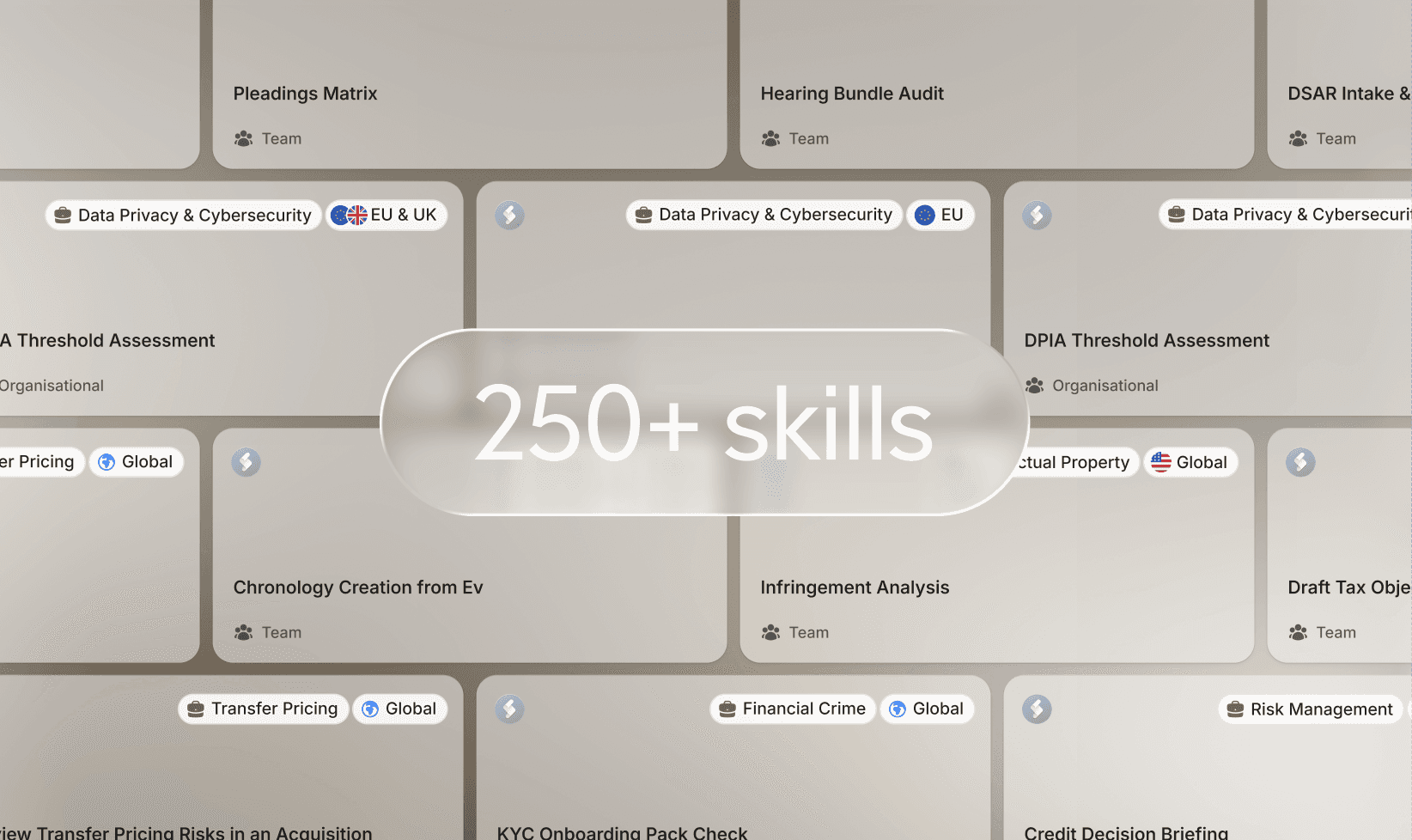
Legora comes with a Skills Library of more than 250 Skills, built by our legal engineers across practice areas and jurisdictions. Whether you work in litigation, real estate, corporate or in-house, there are Skills ready to use as they are or adapt to how your team works.
The Library is also home to every Skill you have access to: your own, your team's, and your organization's. Your personal Skills sit alongside those your colleagues have shared with you, and organization-wide Skills published by knowledge managers are available to everyone with access. The Library is organized by a clear taxonomy, so the right Skill is easy to find, and it's browsable enough that you might discover a capability you didn't know existed.
Governance and trust
You choose what the Agent uses. Sharing a Skill with someone makes it available to them, but their Agent won't use it until they install it. The same applies to Skills published across the organization, and to Skills you build yourself. Nobody can add a Skill to your Agent without you choosing it.
Admins set the boundaries. Sharing a Skill across the whole organization requires a permission and isn't open to everyone by default. Admins can restrict sharing to specific user groups, and they can remove a Skill that shouldn't be in circulation.
Every Skill can be read. A Skill only changes when someone edits it, and anyone it's shared with can see exactly what the Agent has been given. That matters most for the things you'd never want to change without your knowledge: your standards, your review process and your positions.
Matter permissions still apply. The Skill holds the know-how, and the matter sets what the Agent can access. A Skill used on one matter doesn't carry information from that matter into another.
Skills are now available to all Legora customers.