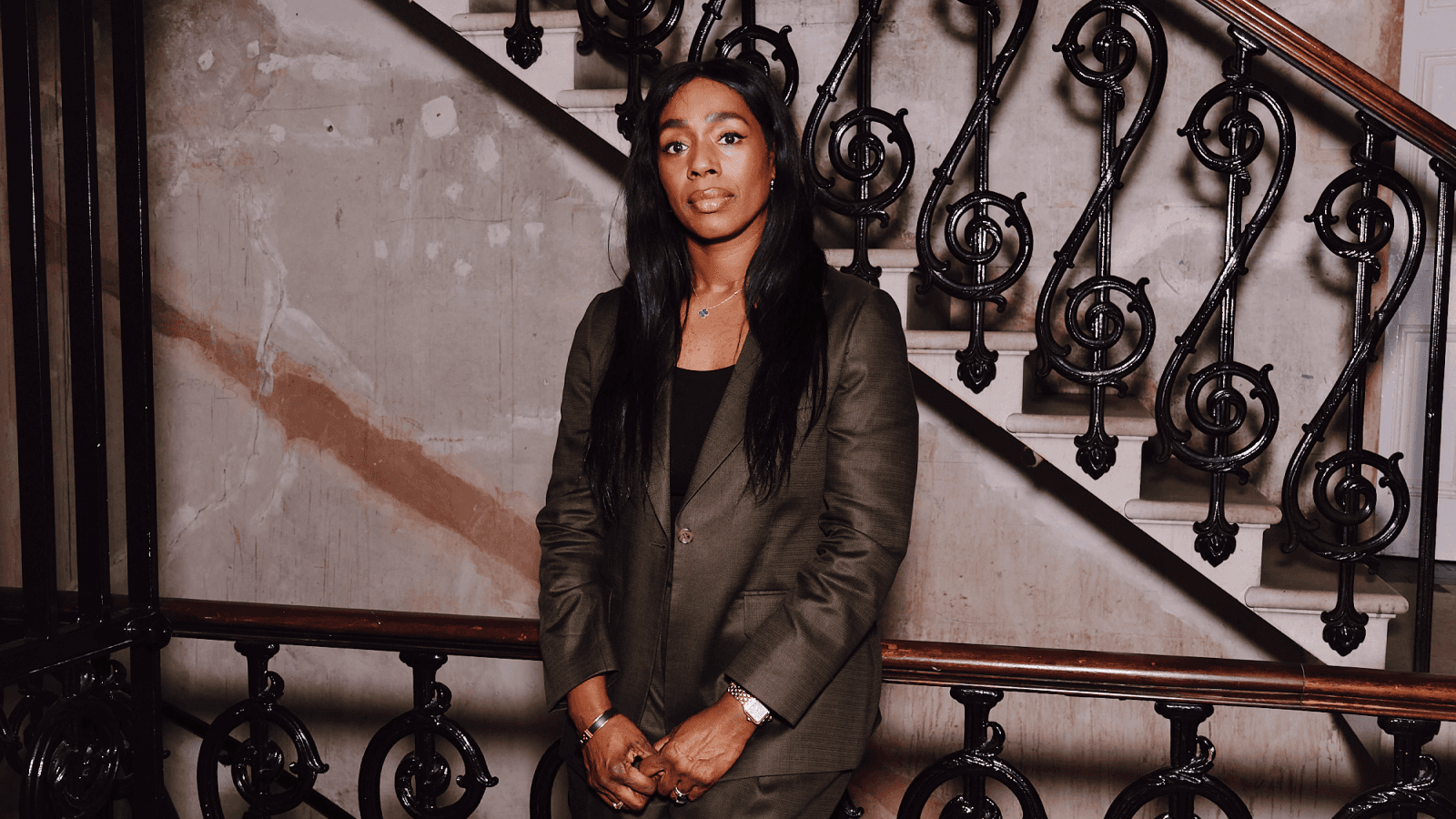
When Laurie-Anne Power KC spoke at Legora’s Her Counsel event in London, the room quickly knew something special was happening.
Her story moves between personal experience and the realities of the legal profession: the moment she was excluded from school at age 11 for refusing to remove her religious head covering; returning to the Bar after the premature birth of her son and discovering that the practice she had spent more than a decade building had suddenly disappeared. It highlights the reality that women entering the profession often still have to work harder to be seen as equal contenders.
Her Counsel brings together women whose leadership, perspective, and resilience are helping shape what the legal profession looks like today. At a moment when law is evolving through technological change, new commercial realities, and shifting expectations of leadership, we create space to reflect on the journeys behind that progress. In the conversation that follows, Laurie-Anne reflects more deeply on the experiences that shaped her path to the Bar’s highest ranks. Her story is one of conviction, community, and strategic resilience, and is a reminder that progress in law comes from preparation, credibility, and developing the judgment to know when to push and when to wait.
The making of an advocate
Laurie-Anne’s career spans more than two decades at the Bar. A leading criminal and human rights barrister, she has built her practice around some of the most complex and high-stakes cases in the system.
Laurie-Anne’s instinct to fight for justice began long before her formal entry into law. On her first day of secondary school, she was told to remove her religious head covering. She refused.
“I was empowered by the fact that I come from a very strong family who taught us from an early age that you stand by the principles that you believe in. So I said, ‘Well, I’m not taking it off.’”
The headmaster marched Laurie-Anne outside the school gates and she was excluded for several weeks while her parents challenged the decision. Even at age 11, she recognised the principle at stake. “I could palpably feel the outrage,” she tells us. “I knew that it was an injustice.”
Years later, she would define the role of a barrister in similarly uncompromising language: “You need someone who’s going to be bold enough and fearless enough to say ‘this is wrong’.”
Laurie-Anne’s instinct to confront power and hold a line under pressure was already present in the girl standing outside the school gates, years before she stepped into a courtroom.
Cultivating community
When Laurie Anne began her career 26 years ago, she entered what she describes as an “opaque” profession. The Bar, she explains, is “still very much shrouded in secrecy,” particularly for those without inherited networks. There was no obvious pathway and no ready-made community waiting to receive her.
In those early years, she and a small cohort of peers cultivated their own kinship. “There was no community of women and there was no community of Black people,” she recalls. “There were a handful of disparate groups who kind of huddled together to find comfort in each other.”
They called each other after difficult hearings, shared advice on drafting applications, compared notes on navigating judges who were, at times, “quite clearly obstructive, quite clearly sexist, quite clearly classist.” There was no formal blueprint: “You just fall into a pattern of communicating with each other when you have really bad days.”
For Laurie Anne, community is a precondition of success rather than a byproduct. She emphasises the importance of taking the time to build a community where it doesn’t exist, so that those rising through the ranks after her do not have to navigate the same terrain alone. “Someone had to do it first,” she says. “You continue to hand it down and to hand it back.”
Challenging institutions from within
For Laurie-Anne, influence begins with presence. Change happens when you’re in the rooms where decisions are made, standing prepared, credible, and able to shape the conversation at the moment it matters most.
“You navigate your way into spaces silently, so that when a big decision is to be made, such as about recruitment, the structure of an organization, or about making someone an equity partner or not, you can affect change from the inside.”
Her approach is rooted in timing and judgment: “There will be things that you can push at a particular time and there are things that have to wait.” Knowing the difference, and knowing how to frame an argument so it can be received rather than resisted, is critical. She reflects, “You get far more with sugar than you do with salt. This is the greatest lesson I’ve learnt from my journey so far.”
This isn’t about the softening of principles, she explains, but understanding power. Change, in her view, is most effective when it’s strategic, deliberate, and takes root from within the very structures it seeks to reshape.
Turning setback into trajectory
One of the most defining periods of Laurie-Anne’s career unfolded not in court, but at home. When her son was born prematurely and spent almost a year in hospital. She had planned financially for maternity leave but had not anticipated what awaited her return: “All of my work was gone. My diary was completely empty.”
After more than a decade of building a formidable practice, she found herself facing a year ahead with no pipeline of work. “The clerks weren’t putting me forward as a viable option because I had a sick child. I had built this career and overnight it felt as though it had disappeared because I chose to have a child.” The message was clear: motherhood had altered how she was perceived.
Laurie-Anne approached the situation with action, turning to the community she had helped cultivate over years at the Bar. She contacted solicitors directly and made herself available. She rebuilt intentionally. Within a year, her diary was full again.
But the experience also sharpened her assessment of her environment. She set her sights on the best defence chambers in the country and pursued the move with uncompromising focus. She was accepted, and now works in one of the most formidable defence sets at the Bar.
The episode captures something central to Laurie-Anne’s career: reliance and agency in equal measure. Community sustained her and strategy repositioned her. Faced with structural disadvantage, she didn’t set out to regain lost ground, she chose to move higher.
Laurie-Anne’s advice to women in law
When asked what she tells women entering the profession, Laurie-Anne offers a candid assessment: “You do have to be better than the other contenders. You have to put more work in.”
There is, she insists, “no substitute whatsoever for preparation and work.” Success is built on readiness. “You are as good as the preparation of your case.”
Failure, too, has a role. “Without the failures, there is no success.” Careers are not linear ascents. They are shaped by recalibration, persistence, and perspective.
Teaching young women that the law belongs to them
Laurie-Anne is unequivocal about the capability of women in the profession: “The best lawyers I know are women. They make formidable, brilliant lawyers because they combine resilience with precision. The adversity of being a woman sharpens judgment. It builds the ability to read a room, to know what should and should not be said, to prepare meticulously, to steady a client, and to go the extra mile. It is not multitasking in a cliché sense. It’s situational intelligence, empathy, and discipline working together.”
Laurie-Anne believes that we need to pay attention to how young girls are encouraged to imagine themselves: “We have to start much earlier, from early teens, before girls are redirected into smaller versions of themselves. We need to teach them that the skills that come naturally to them — judgment, empathy, discipline, resilience — are not soft traits. They are the foundations of a career in law. They do not need to narrow themselves before they’ve even begun.”
At age 11, Laurie-Anne learned to hold her ground at school. Years later, she is working to ensure young women are not pushed to the margins before they have even begun. She describes asking a group of mentees a simple question: In your wildest dreams, what would you do?
She tells us: “One of my mentees replied, ‘In my wildest dreams, I want to do what you do.’ And I said, ‘Stick with me. We can do it.’”
Five years later, the mentee is about to begin her Bar course.
For Laurie Anne, the issue is often a lack of permission rather than ambition. Women need exposure, and someone willing to say, clearly and credibly, that those ambitions are possible. She tells us: “Their wildest dreams are not wild at all. They’re completely achievable.”
The power of instinct and discernment
Her final reflection returns to judgment. Instinct matters, she says, but it isn’t infallible. “Sometimes our gut is a protective mechanism against taking risks.” The skill lies in knowing when to trust your instinct, when to listen to those around you, and when to recalibrate. Over time, that discernment sharpens, shaped by experience, failure, preparation, and community.
Laurie-Anne’s focus now extends beyond her own path: helping ensure the next generation of women enters the profession with greater clarity, stronger support, and fewer barriers to overcome.